


US Midterms Polls: What Nigeria Can Learn Ahead of 2027
By Joy Nkeiruka Chukwunonye
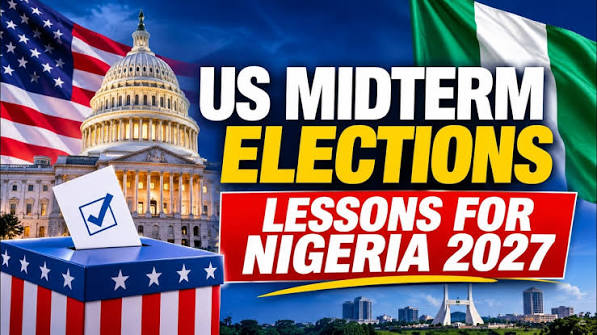
Nigerian households do not need a survey to understand the impact of rising prices on everyday life. This is why the November 3, 2026, United States midterm elections deserve attention as Nigeria prepares for its 2027 general elections. Democrats won control of both chambers of Congress, flipping at least seven Republican-held Senate seats and securing more than 250 of the 435 seats in the House of Representatives. Many voters expressed dissatisfaction with the rising cost of living, while some religious groups that traditionally supported Republicans appeared to reconsider their voting preferences.
Before the election, an important question was whether religion still determined how Americans voted. A Pew Research Center survey of 8,937 adults, conducted between May 5 and 11, 2025, found that 56 per cent said religion had little or no influence on their voting decisions, while 25 per cent said it influenced them a great deal or quite a bit. However, 51 per cent of white evangelical Protestants said religion strongly influenced their voting decisions. This suggests that religion remains an important consideration for some groups, although it is not the primary factor for most Americans.
Pre-election surveys also identified economic concerns as major electoral issues. An October Associated Press-NORC survey found that about eight in ten voters considered the economy or cost of living among their biggest concerns. Approximately two-thirds also identified healthcare and the war involving Iran as important issues. Another survey found that only 17 per cent of American adults approved of President Donald Trump’s handling of the cost of living. The elections therefore took place against a backdrop of widespread economic dissatisfaction.
The results also revealed changing political preferences among religious groups. Catholics, who supported Republicans by 59 per cent to 39 per cent in the 2024 presidential election, were almost equally divided between the two parties in 2026. About 77 per cent of voters without religious affiliation supported Democrats, accounting for 27 per cent of the electorate. White evangelical Protestants largely remained loyal to Republicans, although their share of voters declined from 23 per cent in 2024 to 17 per cent in 2026.
These figures suggest that religion did not cease to influence political decisions, but religious affiliation was no longer sufficient to guarantee support for a particular party. Some voters reconsidered their political preferences amid economic difficulties, while those with stronger religious and political commitments largely maintained their traditional loyalties.
For Nigeria, the first lesson concerns religious mobilisation. Chatham House reported that voter turnout in the 2023 general elections was just 27 per cent, with voting patterns reflecting strong connections to the ethnic and religious identities of leading candidates. Politicians can exploit identity-based appeals to attract support without presenting clear and practical plans for addressing the country’s challenges. Such electoral victories can produce a narrow mandate, particularly when a candidate wins with the support of only a small proportion of registered voters.
The second lesson is the importance of issue-based voting. American voters consider issues such as rising prices and healthcare costs when choosing their representatives. Nigerian voters should similarly look beyond candidates’ religious affiliations, ethnic backgrounds, and political parties. They should demand clear commitments on food prices, unemployment, insecurity and poverty, and assess candidates based on their ability and willingness to fulfil those promises.
The third lesson is political accountability. In the United States, midterm elections allow voters to assess a president’s performance halfway through the presidential term. Nigeria has no comparable nationwide election between general elections. Citizens must therefore monitor their leaders throughout their tenure. Legislators, the judiciary, the media, and ordinary citizens all have important roles to play in demanding transparency and accountability.
The American experience does not suggest that religion is irrelevant to politics, nor does it mean Nigeria and the United States operate under identical political conditions. However, it demonstrates that religious loyalty does not always take precedence over people’s everyday economic needs. As 2027 approaches, Nigerian voters should look beyond religious and ethnic identities and evaluate political leaders based on their records, policies, and performance.
Joy Nkeiruka Chukwunonye
Department of Development and Strategic Communication
University of Abuja.
