




UniAbuja Students Launch Energy Conservation Campaign
By Igboka Chinenye and Chukwudi Divine
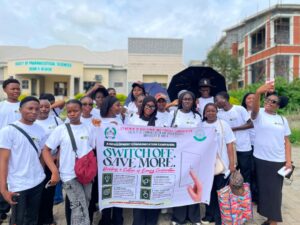
Students of the Department of Development and Strategic Communication, Faculty of Communication and Media Studies, University of Abuja, have launched a campus-wide energy conservation campaign aimed at promoting responsible electricity use and encouraging behavioural change among members of the university community.
The campaign, themed “Switch Off. Save More.”, was organised by one of the student campaign groups under UA DCS 108: Development Communication Campaign as part of the practical component of the course. It seeks to encourage students, lecturers and non-teaching staff to switch off lights, fans, air conditioners and other electrical appliances whenever they are not in use.
As part of the awareness exercise, the students visited faculties, lecture theatres, administrative offices and student hostels, where they sensitised members of the university community on the importance of conserving electricity. They also placed educational posters and reminder stickers carrying energy-saving messages beside electrical switches, classroom entrances, offices and other strategic locations to reinforce responsible energy-use habits.
Speaking during the campaign, the course lecturer, Mr. Auwal Sani, described the initiative as a practical demonstration of development communication in addressing contemporary societal challenges.
”Development communication is about influencing positive behavioural change through strategic communication. This campaign demonstrates that sustainable development begins with everyday actions. By encouraging members of the university community to adopt simple energy-saving habits, our students are applying classroom knowledge to solve real problems within their immediate environment,” he said.
Sani noted that the exercise forms part of the department’s experiential learning approach, which enables students to design, implement and evaluate communication interventions capable of producing measurable social impact.
Members of the university community welcomed the initiative and expressed support for efforts to reduce unnecessary electricity consumption. Many acknowledged that electrical appliances are often left running after lectures and office activities, noting that the reminder stickers would help promote more responsible energy-use practices.
The campaign also created an avenue for dialogue with key university stakeholders. At the Faculty of Veterinary Medicine, academic staff commended the initiative while highlighting the challenge of irregular electricity supply affecting teaching, research and laboratory practical sessions. They appealed to the university management to take measures to improve electricity supply and enhance the learning environment.
One of the student campaign leaders said the objective of the exercise extends beyond reducing electricity costs.
”Our goal is to help build a culture where conserving energy becomes a daily habit. If students and staff remember to switch off appliances after use on campus, they are more likely to practise the same behaviour in their homes, workplaces and communities,” the student said.
The campaign received approvals from the deans of the participating faculties before implementation, reflecting institutional support for the initiative. Students visited the Faculties of Communication and Media Studies, Environmental Sciences, Pharmaceutical Sciences, Agriculture, Science, Veterinary Medicine, Engineering, Management Sciences and Education, as well as the ETF Central Lecture Theatres and student hostels, where they engaged stakeholders and installed campaign materials.
Apart from a minor challenge encountered in one faculty during the installation of reminder stickers, the exercise was conducted peacefully and received widespread cooperation from both academic and non-academic staff.
The campaign concluded with a renewed call on members of the university community to recognise that sustainable energy conservation depends not only on improved infrastructure but also on individual choices and everyday actions.
The “Switch Off. Save More.” campaign forms part of the Department of Development and Strategic Communication’s commitment to experiential learning, providing students with practical opportunities to apply behaviour change communication, stakeholder engagement and strategic communication principles in addressing real-life development challenges.
Against the backdrop of rising energy costs and growing pressure on Nigeria’s electricity infrastructure, the student-led initiative demonstrates how strategic communication and behavioural change campaigns can contribute to fostering a culture of responsible energy use, one switch at a time.
