



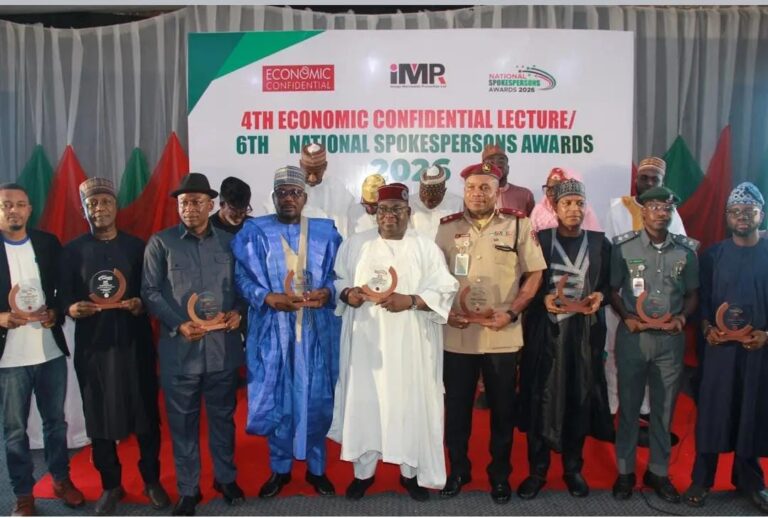
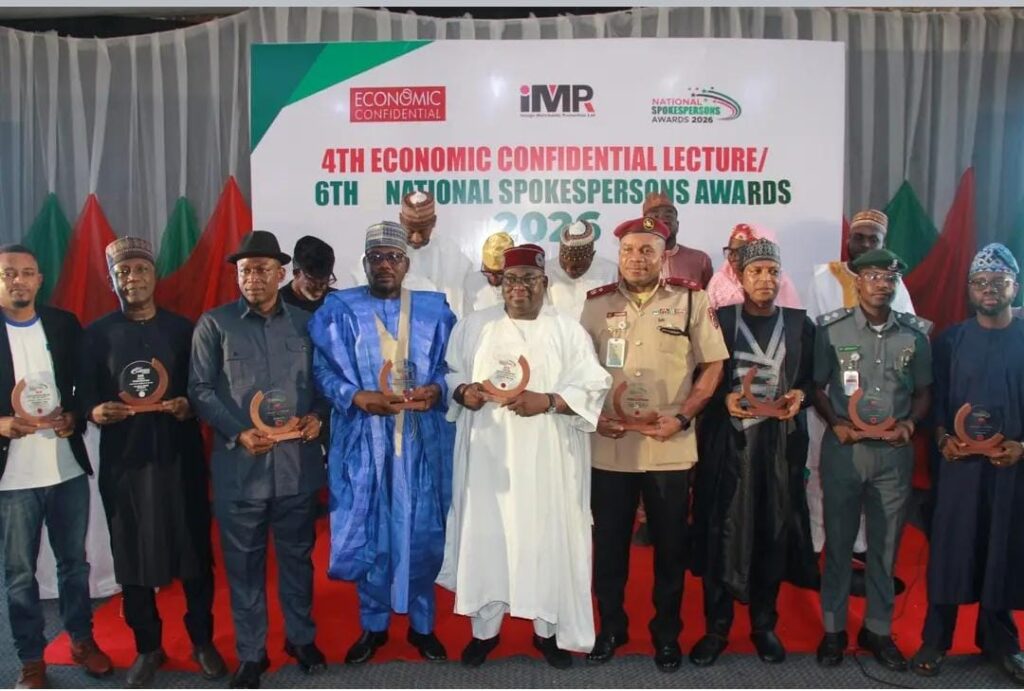
Inside the 2026 National Spokespersons Awards
By Ibrahim Happiness
There are experiences that teach you more in a single day than weeks of lectures ever could. For me, one of those experiences came on Thursday, August 13, 2026, when I walked into the Olusegun Obasanjo Hall of NICON Luxury Hotel, Abuja, not simply as a guest, but as part of the team supporting the 6th National Spokespersons Awards and 4th Economic Confidential Annual Lecture.
The event is one of the flagship annual programmes of Image Merchants Promotion Limited (IMPR), publishers of PRNigeria, Economic Confidential and Spokespersons Digest, where I am currently undertaking my internship. Although the invitation was primarily extended to staff, interns were also given the opportunity to attend, observe the proceedings and contribute to coverage. My colleagues, Omolola Blessing Oladapo and Aniefiok Victoria Asuquo, were also present.
We were picked up from the office and taken to NICON Luxury Hotel. From the moment we arrived, it was clear that this was more than an ordinary event. As an intern, being trusted to participate in a programme of such scale felt like a quiet vote of confidence that our presence and contributions mattered.
My assignment was straightforward but demanding: capture the event as it happened. Armed with my phone, I recorded guests arriving, the hall filling up and different moments as the programme unfolded. It was a reminder that attending an event as a participant is different from attending as a storyteller. When you are covering an event, you are constantly looking for the right moment, expression or angle that can tell the story after the event is over.
That day reinforced something I had learned in the classroom: storytelling does not happen only through writing. Sometimes, it happens through a camera lens, in real time, with no opportunity for a second take.
The 2026 National Spokespersons Awards was particularly significant because of the scale and quality of entries. The edition attracted 171 nominations from corporate organisations, government institutions and communication agencies across the country. Following the initial screening, 99 entries progressed, while 42 were subsequently considered before 30 finalists emerged across 15 categories.
The judging process, chaired by Professor Saudat Abdulbaqi, was based on four key criteria: impact, innovation and originality, campaign reach, and quality of evidence. Seeing how much scrutiny went into the selection gave me a deeper appreciation of what the awards represent. It was not simply about visibility or popularity; the emphasis was on measurable communication excellence and demonstrated results.
Among the notable winners were Celestine Achi, who emerged winner in the Author/Scholar category; Integrated Indigo Limited, named PR Agency of the Year; Andy Odeh of the Nigerian National Petroleum Company Limited, who won Corporate Communication; Comrade Ibrahim Abdullahi Waiya of the Kano State Government, who emerged Crisis Communicator; and Abdurrahman Ahmed Bundi of the Borno State Government, who won Digital Communication.
Other winners included the Office of the Accountant-General of the Federation for Employee Relations; NIPR Kaduna Chapter for Event Management; MAAUN Kano for Knowledge Hub; Abdulmumini Oniyangi of TETFund for Media Relations; and the Federal Road Safety Corps for Public Affairs. Basheer Luqman of Kwara Express Media won Social Media Influencer, while NITDA/CCC – Crisis Communication Hub won Crisis Management. Tolulope Olorunduro of Nigerian Women in PR won Publication, Folusho Adeogun of the Nigeria Customs Service emerged Young Communicator, while Hakama Sidi-Ali of the Central Bank of Nigeria was named Spokesperson of the Year.
The presence of prominent personalities, including the President of the Nigerian Institute of Public Relations (NIPR), Dr Ike Neliaku, and the Chairman of the Independent Corrupt Practices and Other Related Offences Commission (ICPC), Dr Musa Adamu Aliyu, further underscored the importance of the occasion.
The awards were complemented by the 4th Economic Confidential Annual Lecture, which provided a broader platform for discussions around contemporary economic and national development issues. For me, this was an important reminder that communication does not exist in isolation. Effective public communication is closely connected to economic policy, governance, accountability and the ability of institutions to explain complex issues to citizens.
As an intern at IMPR, I have long known and admired Alhaji Yushau A. Shuaib, the organisation’s CEO. I have listened to his lectures, read his articles and studied his work. However, seeing him coordinate and host an event of this magnitude offered a different perspective.
Throughout the programme, I heard guests and colleagues refer to him as “the irreplaceable YaShuaib.” The expression was not simply a slogan. It reflected the respect many professionals in the room had for his contribution to public relations, journalism and strategic communication.
His professional journey helps explain that reputation. A graduate of Mass Communication from Bayero University, Kano, with a Master’s degree in Public Relations from the University of Westminster, London, Alhaji Shuaib began his public relations career as a student and later worked as a Press Secretary in federal institutions, including the ministries of Information, Finance and Health, as well as the National Emergency Management Agency (NEMA).
He subsequently founded PRNigeria and built IMPR into a recognised communication organisation. Under his leadership, the firm has received international recognition, including African PR Awards across several editions and the International Public Relations Association’s Golden World Award for Crisis Management on more than one occasion. In 2020, the firm was also recognised as the Most Creative PR Agency Worldwide by the Global Creativity Index.
Watching him engage dignitaries, coordinate the proceedings and speak about the purpose behind the awards made the lessons I had previously encountered through his writings and lectures feel more tangible. I was seeing communication leadership in practice.
By the end of the event, I was exhausted, but fulfilled. More importantly, I left with lessons that extended beyond the classroom.
I learned that behind every polished award ceremony are months of work, screening entries, verifying claims, coordinating logistics, communicating with stakeholders and ensuring that decisions are properly defended before an independent jury. I also learned that being an intern does not mean being invisible. When young professionals are trusted with meaningful responsibilities, they can contribute to the success of major institutional programmes while gaining invaluable practical experience.
Most importantly, the experience strengthened my understanding of storytelling. Whether through a written report, a photograph or a short video, communication is about identifying what matters and presenting it in a way that connects with an audience.
The 2026 National Spokespersons Awards and Economic Confidential Annual Lecture therefore became more than an assignment for me. It was a practical lesson in strategic communication, event management, journalism and institutional reputation.
For someone studying Strategic Communication, the experience offered something no classroom could fully provide: the opportunity to watch communication professionals work under pressure, interact with important stakeholders and create an event that brought together government officials, corporate leaders, academics, journalists and public relations practitioners.
It was one of the most hectic yet fulfilling days of my internship at IMPR so far. More than anything, it reminded me that the communication profession is not simply about what we learn; it is about what we are able to do with that knowledge when the opportunity comes.
Ibrahim Happiness is a 300-level student of Strategic Communication at the University of Abuja and an intern at Image Merchants Promotion Limited (IMPR). She can be reached at [email protected].
