
UnAbuja, FRSC Unite to Drive Road Safety Culture Among Campus Keke Riders.
By Chukwudi Divine.
What began as a classroom assignment ended as a landmark moment for road safety advocacy at the University of Abuja. On Saturday, the Department of Development and Strategically Communication, Faculty of Communication and Media Studies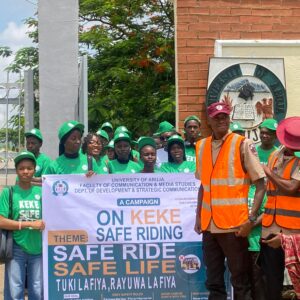 , brought the two-day “Safe Ride, Safe Life” Campaign to a powerful close, drawing together commercial tricycle operators, university officials, the Students’ Union Government, and officers of the Federal Road Safety Corps (FRSC) for a public lecture that was as frank as it was timely.
The campaign, designed as the practical component of UA DCS 108: Development Communication Campaign, gave 100-Level students the rare opportunity to move from theory to action, taking a real community problem and tackling it head-on through advocacy, grassroots engagement, and strategic stakeholder collaboration.
Saturday’s public lecture at the Convocation Ground marked the campaign’s peak. Opened with Islamic and Christian prayers and a formal introduction of guests, the session set a tone that was inclusive, serious, and solution-focused from the start.
Welcoming participants, the SUG Welfare Director, Atiku Abubakar, praised the three-way collaboration between the students, university management, and the FRSC, describing it as exactly the kind of partnership that produces lasting change. The SUG Director of Transport, Umar Shehu Aliyu, added that the campaign was specifically designed to shift behaviour, not just raise awareness, among Keke operators whose daily decisions directly affect the safety of hundreds of students, staff, and visitors.
Course Lecturer Mr. Auwal Sani, whose UA DCS 108 class anchored the initiative, told participants that the campaign reflected what development communication is truly meant to achieve.
Development communication is most meaningful when it moves beyond theory to solve real societal problems. Through this campaign, our students have demonstrated that communication is not only about disseminating information but also about inspiring behavioural change, building partnerships, and improving community well-being. Today’s engagement reflects our commitment to producing graduates who can use communication strategically to address development challenges.
Mr. Sani also took a moment to acknowledge the Keke riders directly, thanking them for their contribution to campus mobility and urging them to hold passengers’ safety above all operational pressures.
The session’s most direct voice came from FRSC representative Mr. Samaila Tabak, who did not mince words. He reminded riders that the three-wheel structure of commercial tricycles makes them inherently less stable than other vehicles, meaning that speed is not just reckless, it is dangerous by design. He pointed to the 25 kilometres per hour speed limit signposted at the university gate, stressing that this figure exists for a reason.
No passenger’s urgency is worth risking lives. Your first responsibility as a rider is to ensure that every passenger arrives safely. Obey speed limits, avoid overloading, and always drive defensively.
FRSC officers went further, walking participants through traffic signs, defensive driving techniques, vehicle maintenance basics, and the cumulative dangers of speeding and overloading, turning the lecture hall, briefly, into a road safety classroom.
But the session’s most revealing moment came during the open question-and-answer segment, when the riders themselves spoke candidly. They flagged the poor state of the road leading to the Faculty of Communication and Media Studies as a persistent problem, one that damages their tricycles, slows transit, and drives up maintenance costs. They also disclosed something that may surprise many students: that some passengers actively pressure riders to speed, particularly when running late for lectures or exams. The riders appealed directly to students to leave for class earlier and stop encouraging unsafe driving that puts everyone at risk.
One rider summed up the mood of the room simply: This programme has reminded us that every trip carries a responsibility. We now better understand the importance of obeying speed limits, avoiding overloading, and ensuring that passengers are safely seated before moving. We appreciate the students, the lecturers, and the FRSC for bringing this message directly to us.
Throughout the two-day campaign, which included a campus-wide road walk on Friday and Saturday’s public lecture, students distributed flyers and road safety stickers, engaged riders in one-on-one conversations, and used placards and a public address system to carry their message across faculties, administrative blocks, and key campus routes.
The programme closed with refreshments and a call to action: that the University of Abuja, the SUG, the FRSC, riders, and students must continue working together if a genuine culture of road safety is to take root on campus.
For the 100-Level students behind it all, the campaign was more than a grade. It was proof that strategic communication, when aimed at the right people, with the right partners, and the right message, can move beyond information and actually change how people behave.
