


Qualifications and the Responsibility to Deliver
By Happiness Ibrahim
A certificate can tell us what someone has studied, a qualification can show what they have achieved, and a professional recognition can confirm a level of expertise. But none of these, on their own, can answer a more important question: What difference does that knowledge make?
That question came to mind after I received a personal email on Tuesday, September 29, 2026, from Dr. Abiola Salami, Principal of CHAMP Global Leadership Consulting and Founder of The Peak Performer Africa. The email contained a link to his latest article, which reflected on professional qualifications and what should ultimately follow them.
Dr. Salami’s reflections resonated with me because they went beyond the usual celebration of certificates and professional recognitions. They raised a broader question about the purpose of learning: What becomes better because of what we have learned?
In his article, Dr. Salami reflects on receiving four professional recognitions within a relatively short period: FNIM, FCIPD, FCIPM and ACIB. Rather than treating these achievements as the destination of his professional journey, he considers the responsibility attached to them.
He describes this challenge as the Qualification-to-Performance Gap—the distance between what an individual is qualified to do and the value that person actually creates by applying knowledge and skills.
That idea made me reflect on my own journey as a final-year student of Development and Strategic Communication at the University of Abuja.
As I approach graduation, I am increasingly convinced that education should be measured by more than the certificate it eventually produces. Its deeper value lies in the knowledge, judgement, skills and confidence it gives us to confront real problems and make meaningful contributions.
Beyond the Classroom
For many students, university life is largely defined by lectures, assignments, examinations and the pursuit of academic qualifications. These are important, but professional readiness requires more than passing examinations.
My six-month internship at Image Merchants Promotion Limited (IMPR), publishers of PRNigeria and Economic Confidential, exposed me to the practical demands of communication beyond the classroom.
The experience introduced me to professional communication, editorial work, teamwork, responsibility and the importance of accuracy in information dissemination. More importantly, it showed me the difference between understanding a principle and applying it effectively.
A student may understand the importance of clear communication, but professional practice requires the ability to communicate with different audiences and respond to different circumstances. Similarly, understanding the principles of responsible journalism is different from demonstrating accuracy, fairness and accountability when producing content.
The experience reinforced an important lesson for me: education provides the foundation, but application gives that knowledge its practical value.
This does not reduce the importance of academic qualifications. Rather, it highlights the need to connect classroom learning with practical experience, critical thinking and problem-solving.
When Certificates Become the Measure
In a society where degrees, professional certifications, fellowships and awards are widely celebrated, it is easy to measure success by the number of credentials attached to a person’s name.
These achievements deserve recognition. They often represent years of discipline, sacrifice, study and professional development. But they should also prompt a deeper question: What do these qualifications enable their holders to do better?
A degree in communication, for example, should equip a graduate with more than theoretical knowledge. It should develop the ability to communicate clearly, understand audiences, analyse information, solve problems and contribute responsibly to public discourse.
Professional certifications should similarly strengthen competence, judgement and the ability to perform effectively.
The problem arises when qualifications become an end in themselves rather than a foundation for further growth and contribution.
A person can possess impressive credentials without necessarily translating them into meaningful outcomes. Conversely, someone who continuously learns, applies knowledge and improves their work may create considerable value without constantly adding new titles to their name.
Professional excellence, therefore, should not be considered solely in terms of what a person has acquired, but also what that person can demonstrate through action.
Professionalism Comes With Responsibility
One of the strongest lessons I drew from Dr. Salami’s article is that professional recognition carries responsibility.
A qualification may demonstrate that an individual has acquired certain knowledge or met established professional requirements. But the responsibility that follows is to apply that knowledge with competence, integrity and a commitment to continuous improvement.
To me, professionalism is reflected in how people approach their responsibilities, make decisions, treat others and respond to challenges. It involves accountability, ethical conduct, sound judgement and the willingness to learn from mistakes.
This is particularly important for young people entering the workforce.
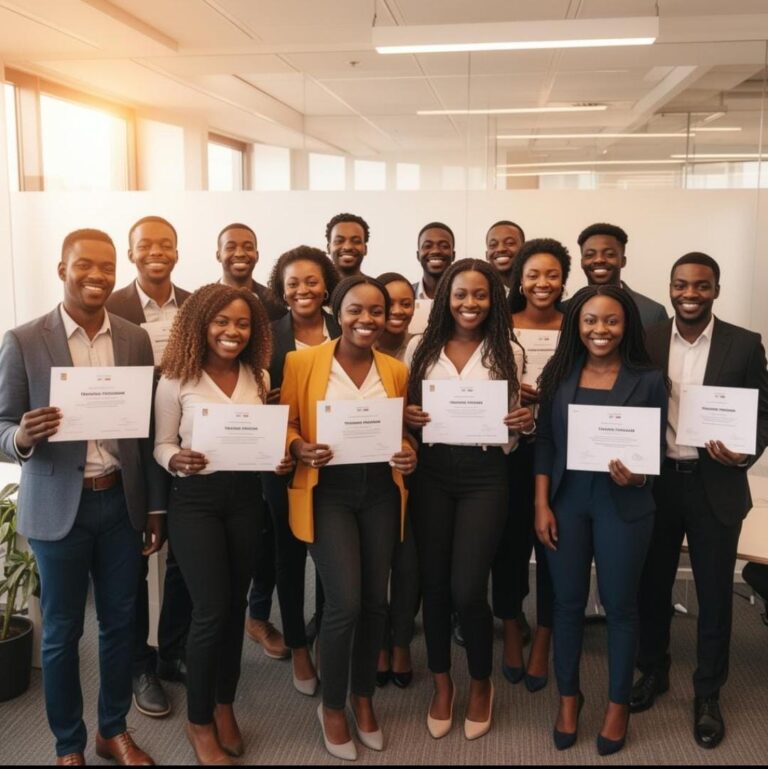
We often celebrate graduation, completing an internship, receiving a certificate or being selected for a fellowship. These milestones matter because they create opportunities. But the more important question is what happens afterwards.
Do we become more responsible? Do our skills improve? Are we better equipped to solve problems? Can people who work with us see the value of what we have learned?
Those questions give professional development its real meaning.
The Responsibility Is Shared
The responsibility for turning knowledge into performance does not rest entirely on individuals.
A qualified professional may have the right knowledge and skills but still struggle in an environment where expectations are unclear, resources are inadequate, leadership is ineffective or opportunities for growth are limited.
Employers therefore have a responsibility to create environments where people can apply their knowledge, develop their skills and contribute effectively.
Educational institutions also have an important role. Academic programmes should create opportunities for practical learning, critical thinking, collaboration and problem-solving alongside theoretical instruction.
Internships, mentorship, research and experiential learning can help bridge the gap between what students learn and what professional environments demand.
The responsibility is therefore shared. Individuals must be willing to learn, practise and improve. Educational institutions must prepare students for the realities of professional life. Employers must create conditions that allow people to turn their capabilities into results.
The goal should not simply be to produce qualified individuals, but to build people and systems capable of converting knowledge into meaningful outcomes.
What This Means for Young Professionals
As a final-year student preparing to move from university into the next stage of my life, this conversation has become particularly relevant.
It has encouraged me to look beyond the immediate goal of earning a degree and think more carefully about the professional I want to become.
For me, graduation will not be the end of learning. It will be the beginning of another phase of learning through experience, responsibility and continuous development.
I want to strengthen my communication skills, improve my critical thinking, learn from experience and apply what I know to real challenges.
Young people should therefore see qualifications as tools for development rather than the sole measure of success.
A certificate may open a door, but what happens after entering that door depends largely on how knowledge, character and opportunity are put to use.
From Qualification to Contribution
Dr. Salami’s article has reinforced my belief that professional development should ultimately lead to greater contribution.
For individuals, this means asking whether the knowledge and skills we acquire are improving the way we work, make decisions and solve problems.
For educational institutions, it means considering whether graduates leave with the practical capabilities required to apply what they have learned.
For employers, it means creating opportunities for people to translate knowledge into stronger performance, innovation and professional growth.
And for professional bodies, it means ensuring that qualifications remain connected to the standards, responsibilities and contributions expected within a profession.
The qualifications we earn are important milestones, but they should also be invitations to greater responsibility.
Ultimately, the value of education and professional development is revealed when what we learn begins to improve the way we think, work, serve and contribute to society.
Perhaps the question we should carry with us is not simply what are we qualified to do? but what are we doing with what we have learned?
Because the true measure of a qualification is not only what it says about its holder, but also what becomes better because that person possesses it.
Happiness Ibrahim is a 400-level Strategic Communication student at the University of Abuja. She can be reached at [email protected].
